Palm Beach County's own procurement documents tell you something the decades of headlines never quite captured. A construction manager solicitation for Cam D. Milani Park lists a start date of September 2026 and a finish by September 2027, with a preliminary construction estimate of $7 million. If that timeline holds, the fence and equipment showing up on South Ocean Boulevard this month mark the end of a fight that started before most current residents owned property here.
But the park breaking ground is not the park either side spent four decades arguing about. It's a smaller, slower, more provisional version of it, and the difference matters if you've lived through even part of this saga.
The Fight, in Brief
Cam and Lucia Milani bought just over five acres on South Ocean Boulevard in 1974, intending to build 130 multi-family units. The Town fought it. Years of litigation later, a settlement allowed 65 units instead, but that plan never got built either. With the land sitting idle, Lucia Milani sold the parcel to Palm Beach County in 1987 for $3.9 million, on one condition: it had to become a park named for Cam Milani.
That condition sat mostly dormant for another two decades. A 2010 settlement agreement between the Town and the County set the terms that still govern the project today, including a requirement for 100 parking spaces on the parcel's west side, the piece residents worried about most. The county has already used one of the two five-year extensions the agreement allowed it, and by 2024 was signaling it intended to move forward for good.
The Number That Actually Changed
Here's the detail that gets lost in "the park is finally happening" summaries: the parking count residents fought over for years didn't survive intact. Late last year, the County agreed to build just 46 spaces in Milani Park's first phase, not the 100 spelled out in the settlement. The remaining 54 spaces are pushed into a second phase with no scheduled date, left, as county officials have put it, to a time to be determined later.
That's a real concession, and it's the mechanism behind why this park looks different on paper than the one Highland Beach spent so long resisting. A 100-space lot reads as a regional beach destination. A 46-space lot, with the other half open-ended, reads as something closer to a quiet access point that may or may not ever fully materialize as originally designed. Neither view quite captures what happened. It ended in a number, and the number is roughly half.
The county's own permitting paperwork, filed with the Town in mid-April, laid out how it intends to comply with the 2010 agreement's 43 separate conditions, everything from lifeguard staffing to restroom availability. Town officials were told at that point construction could start as early as June, with an 18-month build stretching completion into late 2027, a slightly longer runway than the September-to-September window listed in the county's construction manager solicitation. Public projects rarely hit their first quoted date exactly. What's fixed now isn't the month, it's the direction.
What's Actually Going In
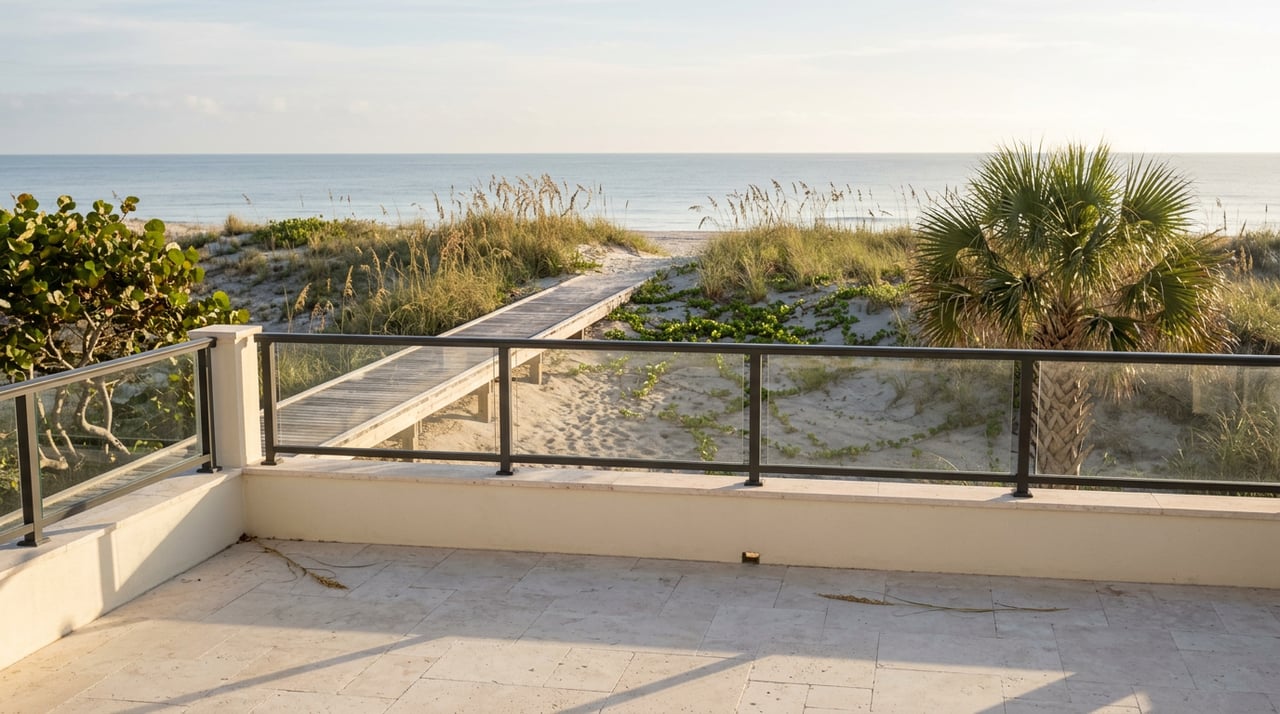
The 5.29-acre site, straddling A1A near Spanish River Boulevard, is planned to include a guardhouse, a restroom and lifeguard building, and an elevated boardwalk built from Accoya wood, a treated timber chosen for its durability in beachfront conditions. The county has already commissioned public art for the boardwalk itself: a $57,550 contract to design imagery into the railing panels and seat tops, inspired by local coastal ecology and the site's history. That call went out at the end of 2025, with contract approval then expected by early July 2026.
The property also includes Yamato Rock, a snorkeling spot long popular with residents, named for the early 20th century Yamato Colony that once worked land in the area. It's easy to miss in the parking and traffic debates, but it's part of what's actually inside the park boundary once this phase is complete.
The architecture firm Brooks + Scarpa has been developing the design since 2025, and conceptual plans were presented at a public hearing that drew an unusual amount of local attention, largely because Lucia Milani herself testified in support of the residents' concerns, a reversal from the family's original push for the park.
How the Road Work Lines Up
If there's a piece of good news buried in the construction schedule, it's that this isn't landing on top of another major disruption. The $8.3 million FDOT resurfacing and widening project on A1A, which ran for more than a year and reshaped the road with new five-foot bike lanes and drainage upgrades, was already "substantially complete" as of January 2026. As Boca Daily News reported, Town Manager Marshall Labadie summed up where things stood at the time:
"For most people in town, the project is done."
The one piece still outstanding back then, lighted pedestrian crosswalk signals, moved forward this summer. In August, Highland Beach commissioners approved a $283,920 agreement with Lux Solar Inc. to install in-ground LED crossing lights at eight mid-block crosswalks along A1A, part of a broader $375,000 state-funded safety project that also addresses drainage issues the resurfacing work left behind. That contract still needs a formal notice to proceed before the clock starts on its six-month build window, so the exact timing hasn't been set.
Put together, the road work that would have complicated Milani Park construction is largely finished, and the pedestrian safety upgrades that make sense for a beachfront park with cars parking along A1A are already funded and moving. Whether that was deliberate sequencing or convenient coincidence, residents are getting the infrastructure without absorbing two overlapping construction zones at once.
What to Actually Watch For
The open question isn't whether Milani Park happens now. It's whether Phase 2 ever does. The remaining 54 parking spaces have no committed date, and the project timeline has shifted over nearly 40 years. If you want to track it directly, Highland Beach's official Milani Park page lists the district's county commissioner contact for anyone who wants updates or wants to weigh in before that second phase gets scheduled.
For now, what's arriving this year is smaller than what the Town spent decades fighting and smaller than what the 2010 settlement originally called for. Whether that reads as a win, a placeholder, or something in between probably depends on which side of the parking debate you were on. Either way, the fence going up on South Ocean Boulevard this month is worth watching, because it's the first physical evidence in 40 years that this argument has an actual end date attached to it.
If you're keeping an eye on how projects like this shape property values and day-to-day life along the coast, Jon Lewis has been tracking Highland Beach long enough to know which changes matter and which are just noise. Let's Connect if you'd like to talk through what's happening in your part of town.
This article is general information, not legal, tax or financial advice. Consult a qualified professional about your situation.